Category: Automotive Wire Harness | Vehicle Upgrade | OEM & Custom Wiring Solutions
For automotive parts importers and in-vehicle electronics OEMs, a door wiring harness may look like a relatively simple cable assembly. In reality, it is one of the vehicle wiring components exposed to continuous mechanical movement.
Every time a vehicle door opens and closes, the harness around the hinge or door-to-body transition may bend, twist and move. At the same time, the area can be exposed to rainwater, humidity, dust, temperature changes and road contaminants.
This creates several recurring problems:
Wire fatigue after repeated bending
Insulation cracking or abrasion
Water entering through poorly sealed connectors
Terminal oxidation and corrosion
Intermittent electrical connections
Incorrect cable length during vehicle installation
Connector mismatch between different vehicle models
For companies sourcing a custom automotive door wiring harness or car extension cable harness, choosing a supplier based only on price can create expensive field failures later.
The better approach is to evaluate the harness according to its flexibility, sealing, connector quality, electrical testing, dimensional accuracy and customization capability.
1. What Is a Custom Automotive Door Wiring Harness?
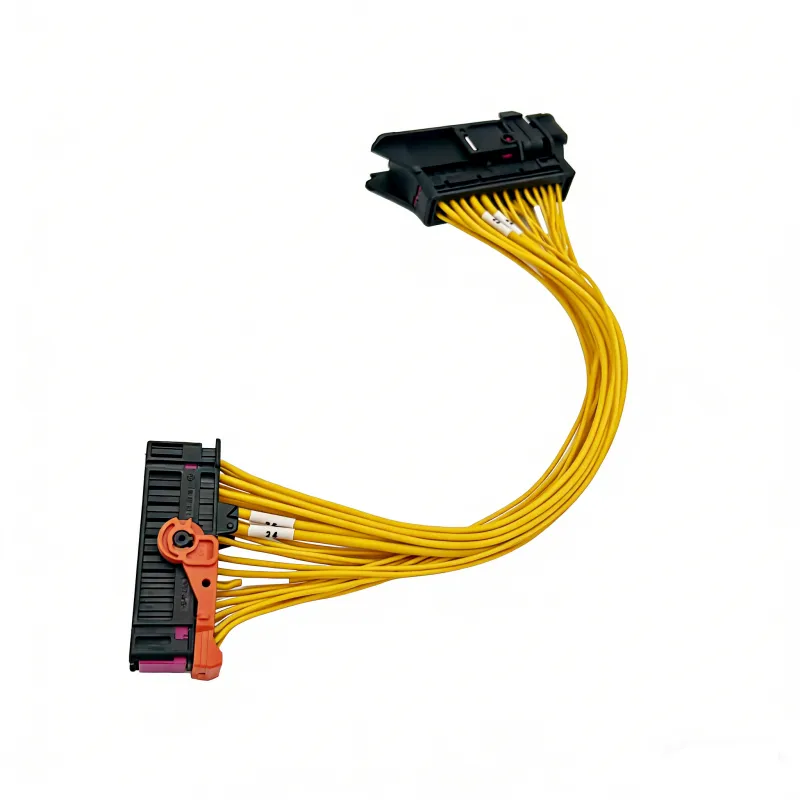
A custom automotive door wiring harness is a cable assembly designed to connect electrical and electronic components between the vehicle body and door.
Depending on the vehicle configuration, it may connect:
Power windows
Door locks
Door control modules
Speakers
Side mirrors
Door lighting
Cameras
Ambient lighting
Keyless-entry components
Seat or door-related control systems
Other aftermarket electronic devices
Unlike a static cable assembly, the door harness needs to accommodate movement.
A typical installation includes a flexible section passing through or close to the door hinge area. This section needs to maintain electrical continuity while repeatedly changing position.
That means a suitable custom automotive door wiring harness should be designed around both the electrical circuit and the mechanical movement of the vehicle door.
SAE's USCAR12 wiring-component design guidelines specifically address areas including electrical continuity, electrical isolation/sealing, harness assembly, vehicle assembly and serviceability, showing why connector and harness design cannot be evaluated only from an electrical perspective.
2. Why Do Standard Door Extension Cables Often Fail?
One of the most common procurement mistakes is treating a door extension cable as an ordinary cable.
A general-purpose cable may have the correct:
Voltage
Current
Number of conductors
Connector type
but still fail after installation because its mechanical and environmental requirements were not considered.
Problem 1: Repeated Bending
The door repeatedly changes position during daily vehicle use.
If the cable construction, bend radius or routing is unsuitable, repeated flexing can concentrate mechanical stress at the same section of the wire.
Over time, this can result in:
Conductor fatigue
Insulation damage
Increased electrical resistance
Intermittent circuits
Complete conductor breakage
A technical discussion of automotive harness design also identifies door harnesses as a distinct application because they repeatedly flex at the hinge area, making bend radius, flexible conductor construction and strain relief important design factors.
Problem 2: Water Ingress
Door areas are not completely protected from moisture.
Rainwater, car washing, condensation and humidity can expose connectors and cable entry points to water.
If the connector or seal is poorly designed, moisture may reach the terminal.
Automotive service documentation provides real examples: a GM service bulletin instructs technicians to inspect front and rear door harness-to-body connectors for water intrusion and to check terminals for corrosion.
Problem 3: Terminal Oxidation
Once moisture reaches an unprotected metal contact, corrosion can gradually increase contact resistance.
Possible symptoms include:
Intermittent window operation
Door-lock malfunction
Mirror failure
Speaker interruption
Sensor communication problems
Diagnostic fault codes
A Tesla service bulletin similarly instructs technicians to inspect a front-door harness connector for corrosion and replace the door harness when corrosion is present.
Therefore, connector sealing is not simply an optional feature. For many door-harness applications, it is an important part of long-term electrical reliability.
3. How Should Buyers Choose the Right Car Extension Cable Harness?
When sourcing a car extension cable harness, buyers should evaluate six areas:
1. Flexibility
Can the cable tolerate the required repeated movement?
2. Sealing
Can the connector and cable-entry structure prevent moisture from reaching the electrical contacts?
3. Connector Compatibility
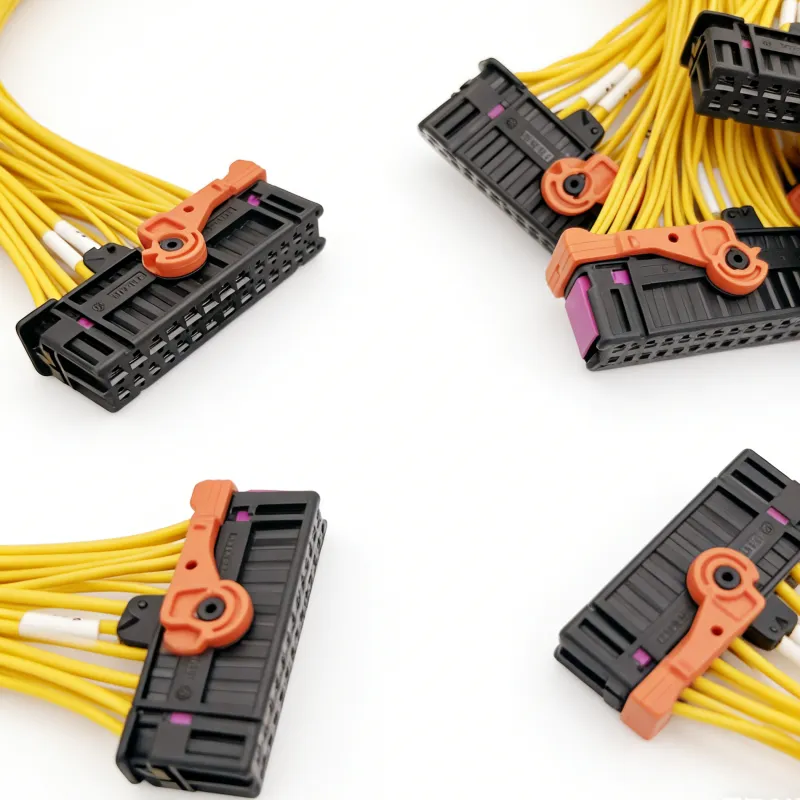
Does the connector match the original vehicle component and installation position?
4. Electrical Performance
Can every circuit maintain stable continuity and insulation performance?
5. Dimensional Accuracy
Does the cable have the correct overall length, branch length and connector orientation?
6. Production Consistency
Can the manufacturer reproduce the same specification for both sample orders and larger production batches?
A reliable supplier should be able to discuss these points before quoting rather than simply asking for the required cable length.
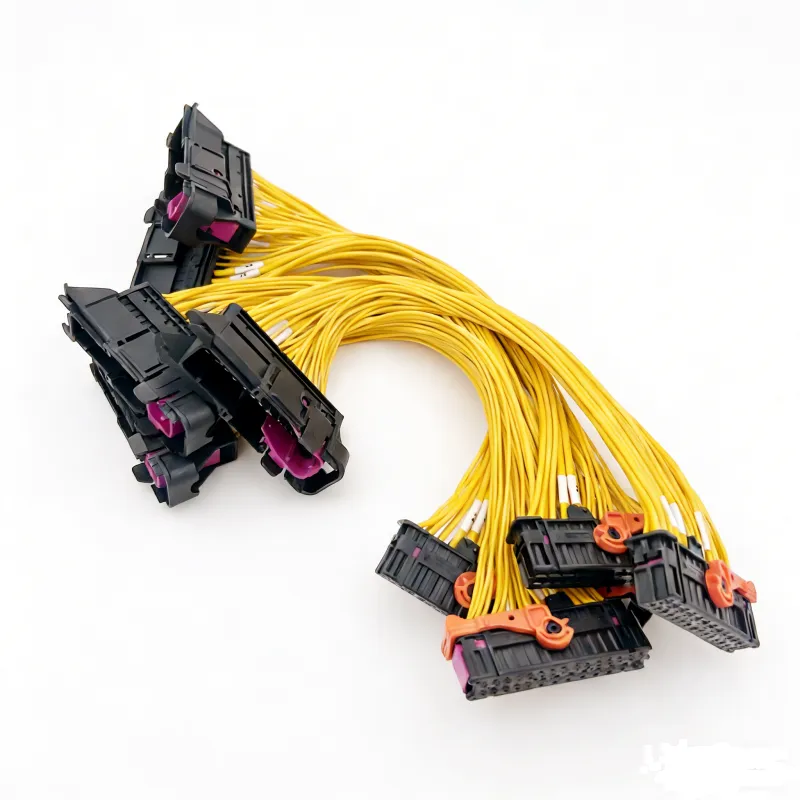
4. Product Selection: What Makes a Reliable Custom Door Harness?
For vehicle upgrade projects, a customized harness should generally be selected according to the actual installation environment.
Flexible Wire Construction
The flexible section should be selected according to the required movement and bending conditions.
Important factors include:
Conductor construction
Wire diameter
Insulation material
Flexibility
Bend radius
Operating temperature
Abrasion resistance
The objective is to prevent the bending force from concentrating repeatedly at one location.
For a door application, the cable should not simply be “soft.” It needs an appropriate combination of flexibility, mechanical durability and electrical performance.
Sealed Connectors and Cable Entry Protection
A sealed connector can help reduce the risk of moisture reaching the terminal interface.
Depending on the application, the harness may incorporate:
Rubber seals
Single-wire seals
Sealed connector housings
Grommets
Protective sleeves
Corrugated tubing
Strain-relief structures
The complete sealing system matters.
An IP-rated connector alone does not automatically mean that the entire harness assembly has the same environmental protection. The cable entry, mating interface, seals and surrounding installation structure also need to be considered.
SAE's USCAR12 guidance includes electrical isolation and sealing among the functional areas that should be considered during wiring-component design.
5. Technical Parameters Buyers Should Confirm
Before ordering a custom automotive door wiring harness, procurement teams should prepare a clear technical specification.
| Parameter | What Buyers Should Confirm |
|---|---|
| Cable Type | Automotive-grade wire/cable suitable for application |
| Number of Cores | Based on electrical circuit requirements |
| Wire Size | AWG or mm² |
| Rated Voltage | According to vehicle electrical system |
| Current Capacity | Based on connected load |
| Operating Temperature | Based on actual installation location |
| Flexibility | Required for door movement |
| Overall Length | According to vehicle installation |
| Branch Length | If applicable |
| Connector | Part number / mating connector |
| Terminal | Terminal specification and plating |
| Sealing | Required sealing structure |
| Protection | Sleeve, conduit, tape or other protection |
| Connector Orientation | Critical for installation |
| Testing | Continuity, short circuit, insulation, etc. |
| Quantity | Sample, small batch or mass production |
For vehicle upgrade projects, connector orientation and cable length deserve particular attention.
A harness can be electrically correct but still fail installation if:
The connector faces the wrong direction
The cable is too short
The branch is too long
The clip position is incorrect
The bend section is located incorrectly
This is why custom production should be based on an actual drawing, sample, vehicle model or installation requirement whenever possible.
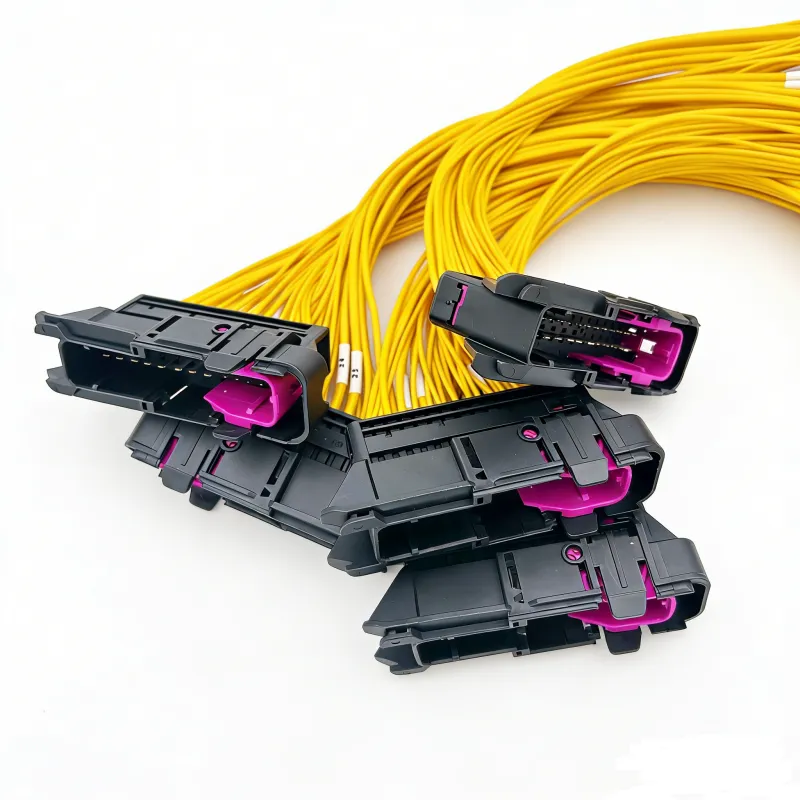
6. Application Scenarios for Custom Automotive Door Wiring Harnesses
A customized door harness can support both original-equipment applications and vehicle upgrade projects.
Power Window and Door Lock Systems
These applications require reliable power and signal connections between the vehicle body and door modules.
The harness must accommodate repeated door movement without creating premature conductor fatigue.
Electric Side Mirror Systems
Modern side mirrors may integrate:
Mirror adjustment
Folding motors
Heating
Turn signals
Cameras
Blind-spot-related functions
As the number of functions increases, the harness may require more circuits and a more carefully controlled connector configuration.
Door Speaker and Audio Systems
For upgraded audio systems, the harness may need to accommodate different connector types, additional speaker circuits or aftermarket components.
Door Camera and Electronic Accessories
Aftermarket cameras, lighting and electronic accessories often require customized cable lengths and connector configurations.
This is particularly relevant for vehicle modification companies that install equipment across multiple vehicle models.
Special-Purpose Vehicles
Special vehicles may require additional electrical functions inside doors or side panels.
A customized car extension cable harness can help integrate these functions without redesigning the complete vehicle wiring system.
7. Why Full-Process Electrical Testing Matters
A door harness should not be considered qualified simply because the connector has been assembled correctly.
Electrical testing is an important part of production quality control.
Depending on the product specification, testing can include:
Continuity Test
Confirms that each circuit is electrically connected according to the wiring diagram.
Short-Circuit Test
Checks for unintended electrical connections between circuits.
Insulation Test
Evaluates insulation performance between relevant conductors and/or conductive parts according to the applicable specification.
Resistance Test
Helps identify abnormal resistance caused by connection or assembly problems.
Terminal Inspection
Checks whether terminals are correctly crimped, positioned and retained.
Connector Inspection
Confirms:
Correct connector
Correct cavity position
Correct terminal insertion
Locking condition
Seal installation
For an OEM project, the exact test method and acceptance criteria should be defined according to the customer's technical specification and applicable automotive requirements.
8. How Should Importers Evaluate a Harness Manufacturer?
For automotive component importers and vehicle-electronics OEMs, the supplier qualification process should go beyond asking:
“What is your price?”
Instead, ask:
Engineering Capability
Can you customize cable length according to vehicle requirements?
Can you work with customer drawings?
Can you reproduce an existing sample?
Can you recommend a suitable wire and connector configuration?
Production Capability
Are cutting, stripping and crimping controlled in-house?
Can you support small-batch orders?
Can you support repeat production?
How are production specifications controlled?
Quality Capability
Is every finished harness electrically tested?
Can test records or reports be provided?
How are connector and terminal defects detected?
How are materials and components controlled?
Customization
Can the connector be changed?
Can wire length be customized?
Can branch positions be adjusted?
Can protective sleeving or sealing structures be customized?
These questions help distinguish a real manufacturing partner from a simple trading company.
9. Why Customized Length and Connectors Matter for Vehicle Upgrade Projects
One vehicle platform may have several versions.
For example, the same vehicle may have:
Standard equipment
Premium equipment
Different door modules
Different audio systems
Different camera configurations
Left-hand-drive and right-hand-drive versions
A universal extension cable may therefore create installation compromises.
A custom harness can instead be produced according to:
Vehicle Model + Year + Configuration + Connector + Cable Length + Installation Position
This makes customization particularly useful for aftermarket brands and automotive electronics OEMs serving multiple vehicle platforms.
10. Yihetai's Solution for Custom Automotive Door Wiring Harnesses
For buyers looking for a stable manufacturing partner, Yihetai specializes in the R&D, production and sales of wires, cables and wiring harness products.
For automotive door extension cable projects, Yihetai can support customization based on the customer's:
Vehicle model
Wiring diagram
Cable length
Number of circuits
Connector requirements
Terminal requirements
Installation dimensions
Application environment
The manufacturing process can be organized around:
Customer Drawing / Sample / Requirement
↓
Engineering Review
↓
Wire & Connector Confirmation
↓
Prototype / Sample Production
↓
Terminal Crimping & Harness Assembly
↓
Continuity & Electrical Testing
↓
Visual / Dimensional Inspection
↓
Customer Approval
↓
Batch Production
↓
Final Inspection & Shipment
This allows Yihetai to support both development-stage samples and repeat production requirements.
11. What Should You Send to Yihetai for a Faster Quote?
If you are an automotive parts importer or vehicle-electronics OEM, providing complete information can significantly shorten the quotation process.
Ideally, send:
1. Vehicle Model
Example: vehicle brand + model + model year.
2. Existing Harness Sample
If available, send the original extension cable or door harness sample.
3. Connector Information
Provide connector photos, part numbers or mating component information.
4. Cable Length
Specify the required overall length and, if applicable, branch lengths.
5. Wire Specification
Provide AWG/mm², number of cores and current requirements.
6. Quantity
Separate prototype quantity from estimated monthly or annual demand.
7. Installation Environment
Explain whether the harness is exposed to:
Moisture
Heat
Vibration
Abrasion
Outdoor conditions
Chemicals or road contaminants
With this information, the engineering team can evaluate the project more accurately and recommend an appropriate production configuration.
12. Procurement Decision: Don't Choose a Door Harness by Price Alone
For a vehicle upgrade project, a cheap harness can become expensive if it causes:
Repeated installation problems
Electrical troubleshooting
Customer complaints
Warranty claims
Replacement costs
Vehicle downtime
The purchasing decision should therefore consider the total project cost, not just the cable unit price.
A useful supplier evaluation model is:
Total Value = Electrical Reliability + Flex Life + Sealing + Installation Accuracy + Testing + Production Consistency + Delivery Stability
A manufacturer that can control these factors is more valuable than a supplier offering only a low initial quotation.
13. Conclusion: Choose the Harness Around the Vehicle, Not Just the Cable
A vehicle door extension harness operates in a demanding environment.
Repeated door movement creates mechanical stress. Moisture can threaten connector interfaces. Poor sealing can contribute to terminal corrosion. Incorrect cable dimensions can make installation difficult.
For this reason, selecting a custom automotive door wiring harness should involve more than matching the number of wires and connector type.
Buyers should evaluate:
Flexible wire construction
Appropriate bend characteristics
Sealed connectors
Terminal protection
Accurate cable length
Connector compatibility
Full-process electrical testing
Production consistency
Custom manufacturing capability
For automotive parts importers and vehicle-electronics OEMs, Yihetai can support customized automotive wiring harness projects based on customer drawings, samples or application requirements.
Whether you need a car extension cable harness for a specific vehicle upgrade or a recurring OEM production program, Yihetai can work with your technical requirements to develop a suitable harness configuration and support the transition from sample to batch production.
Send your drawing, sample, connector information or vehicle application requirements to Yihetai to start a custom automotive door wiring harness evaluation.