Category: Automotive Wire Harness | OEM Manufacturing | Vehicle Wiring Solutions | Buyer Guide
For automotive parts brands, overseas procurement engineers and in-vehicle electronics OEMs, sourcing a custom car wiring harness manufacturer is rarely just a matter of finding the lowest quotation.
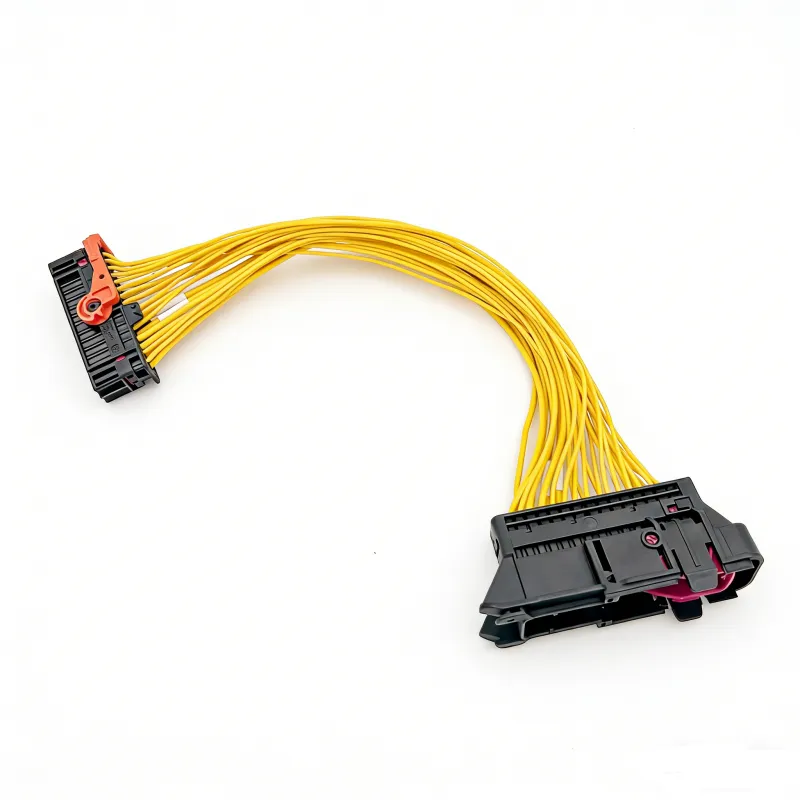
A car door extension wiring harness operates in a particularly demanding part of the vehicle.
Every time the door opens and closes, the harness around the door hinge or body-to-door transition can experience repeated bending and movement. At the same time, connectors may be exposed to moisture, temperature fluctuations, dust and road contaminants.
If the harness is poorly designed or manufactured, the result can be:
Wire fatigue and conductor breakage
Insulation cracking
Connector water ingress
Terminal oxidation
Intermittent electrical connection
Installation problems caused by incorrect cable length
Different quality between prototype and mass production
This is one reason automotive OEMs and aftermarket component companies increasingly evaluate Chinese manufacturers based on engineering capability, quality systems, production flexibility and testing capability, rather than simply comparing trading-company quotations.
China also remains a major automotive wiring-harness manufacturing base. Grand View Research estimates that the global automotive wiring harness market will reach approximately USD 55.0 billion in 2026, with Asia Pacific accounting for the largest regional share.
So, why do buyers choose a Chinese factory for customized car door extension wiring harness projects?
1. The Real Problem: A Car Door Harness Is Not Just an Extension Cable
At first glance, a door extension harness appears simple.
It may only contain:
Several wires
A connector on each end
Protective sleeving
Terminals
Seals
However, its working environment makes the design more complicated.
A typical door harness may need to simultaneously withstand:
Repeated bending + vibration + temperature changes + moisture + electrical load + installation stress.
This means an automotive extension cable should be evaluated as an engineered automotive component rather than an ordinary electrical cable.
For example, a cable can pass a basic continuity test when new but still be unsuitable for a door application if the conductor construction, insulation, bend radius or strain relief cannot tolerate repeated movement.
That is why OEM buyers need to look beyond the initial sample.
2. Why Do Automotive OEMs Look for a Factory Instead of a Trading Company?
A trading company can be useful for simple, standardized products.
But customized automotive harness projects usually involve multiple technical and production requirements.
The difference becomes clearer when comparing the two sourcing models.
| Evaluation Area | Trading Company | Direct Manufacturing Factory |
|---|---|---|
| Engineering Communication | Often depends on external factory | Direct communication with production/engineering |
| Drawing Review | May be limited | Can review manufacturing requirements directly |
| Prototype Changes | Additional communication layer | Faster engineering feedback |
| Cable Customization | Depends on subcontractor | Direct production coordination |
| Connector Customization | Depends on factory | Direct component and assembly control |
| Batch Production | Outsourced in many cases | Production scheduled at manufacturing site |
| Testing | May rely on supplier reports | Testing can be integrated into production |
| Quality Feedback | Multi-party communication | Direct factory feedback |
| Delivery Control | Dependent on subcontractor | Production schedule controlled internally |
| Engineering Changes | More communication steps | Faster change implementation |
This does not mean every trading company is unsuitable.
The real issue is how many layers exist between the buyer and the people actually manufacturing the harness.
For an automotive project with repeated engineering revisions, multiple vehicle configurations and strict delivery requirements, direct factory communication can reduce unnecessary delays.
3. Why IATF 16949 Matters in Automotive Harness Procurement
Automotive buyers should treat quality-system verification as a supplier qualification step.
IATF 16949 is specifically associated with automotive quality management systems and certification within the automotive supply chain. Buyers should verify the actual certificate, scope, manufacturing site and validity rather than relying only on a logo displayed on a website.
For a custom car wiring harness manufacturer, procurement teams should examine how the supplier controls:
Incoming material inspection
Production processes
Engineering changes
Nonconforming products
Traceability
Corrective actions
Final inspection
Customer complaints
Process consistency
This is particularly important when the harness is used across multiple vehicle models.
A supplier may produce a good first sample, but the more important question is:
Can the factory reproduce the same specification and quality over thousands of pieces?
That is the real value of a controlled automotive manufacturing system.
4. Temperature and Flame-Retardant Requirements Cannot Be Ignored
A vehicle does not have one uniform operating environment.
Door wiring may encounter:
Low winter temperatures
High summer temperatures
Cabin heat
Engine-compartment heat in related harness routes
Humidity
Water
UV exposure in some applications
Mechanical abrasion
Therefore, buyers should specify the required operating temperature range and material requirements rather than simply asking for “automotive wire.”
Depending on the application, material selection may involve considerations such as:
Insulation material
Temperature rating
Flame-retardant characteristics
Abrasion resistance
Oil resistance
Chemical resistance
Flexibility
Environmental exposure
The correct specification depends on the actual vehicle application and applicable customer or regulatory requirements.
Procurement recommendation: ask the supplier to identify the wire specification, insulation material and applicable test standard in the quotation or technical data sheet.
5. Repeated Door Movement Makes Flexibility a Core Requirement
This is one of the most important differences between a door harness and a static cable assembly.
A vehicle door may open and close thousands of times during its service life.
The cable section near the hinge therefore experiences repeated movement.
If the design is unsuitable, repeated bending can eventually contribute to:
Conductor fatigue
Insulation cracking
Increased resistance
Intermittent connection
Complete circuit failure
A reliable automotive extension cable for door applications should therefore be selected according to:
Conductor Construction
The conductor needs to match the required flexibility and electrical load.
Cable Diameter
An unnecessarily large cable can make routing and bending more difficult.
Bend Radius
The harness should be routed without forcing the cable beyond its suitable bending characteristics.
Strain Relief
The transition between cable and connector should avoid concentrating excessive mechanical stress at one point.
Protective Structure
Sleeving, tubing or other protection may be required depending on the installation environment.
The correct solution is therefore not simply “use a flexible wire.”
It is:
Select the appropriate wire construction + routing + protection + connector + strain relief as one system.
6. Waterproof Sealing Protects the Connector Interface
Another frequent failure point is moisture entering the connector.
Door areas are exposed to:
Rain
Car washing
Condensation
Humidity
Road splash
If water reaches the terminal interface, corrosion can develop over time.
This can result in:
Increased contact resistance
Intermittent electrical signals
Communication faults
Power loss
Component malfunction
For a custom door harness, the sealing design may include:
Sealed connector housing
Rubber seals
Wire seals
Grommets
Protective tubing
Heat-shrink protection
Proper cable-entry design
However, buyers should avoid assuming that a connector's IP rating automatically represents the entire harness assembly.
The connector, terminal, seal, cable entry and installation structure all need to be evaluated according to the application.
7. Terminal Oxidation Is Another Procurement Risk
A connector can look perfect from the outside while its electrical reliability is compromised by poor terminal protection.
Common causes include:
Moisture
Poor sealing
Incorrect terminal material
Inadequate plating
Contamination
Improper crimping
Long-term environmental exposure
For this reason, automotive procurement teams should ask the supplier about:
Terminal material → plating → crimping process → retention → sealing → electrical testing
rather than evaluating only the connector housing.
For applications exposed to moisture or harsh environments, terminal and sealing specifications should be confirmed against the actual customer requirements.
8. What Technical Parameters Should Buyers Provide?
Before asking a Chinese factory to quote an automotive extension cable, provide as much technical information as possible.
| Parameter | Recommended Information |
|---|---|
| Vehicle Model | Brand / model / model year |
| Application | Door / mirror / lighting / electronics etc. |
| Cable Type | Automotive-grade cable specification |
| Number of Cores | Required circuits |
| Wire Size | AWG / mm² |
| Voltage | System voltage |
| Current | Maximum operating current |
| Temperature | Required operating range |
| Cable Length | Overall length |
| Branch Length | If applicable |
| Connector | Part number / drawing |
| Terminal | Part number / plating |
| Sealing | Sealed / unsealed / IP requirement |
| Protection | Sleeve / conduit / tape |
| Testing | Continuity / short / insulation / other |
| Quantity | Sample / pilot / annual volume |
The more complete the information, the less likely the quotation will be based on assumptions.
9. Why Fast Prototyping Matters to Automotive OEM Buyers
Automotive development projects frequently change.
A connector may be replaced.
A cable may need to become 50 mm longer.
A branch point may need to move.
The installation route may change after a vehicle fit test.
If every engineering change has to pass through several trading and subcontracting layers, sample development can become slow.
A direct factory can potentially shorten the communication chain:
Buyer → Engineering → Production → Sample → Test → Feedback
This is especially useful for:
Vehicle startups
Automotive electronics brands
Aftermarket suppliers
Special-purpose vehicle manufacturers
Tier 2 suppliers
Vehicle modification companies
For prototype procurement, buyers should ask the supplier:
“How quickly can you implement an engineering change after we provide revised drawings?”
This question is often more valuable than asking only for the lowest sample price.
10. Flexible Production: From Samples to Large Orders
Automotive projects can move through several production stages:
Prototype → Pilot Batch → Small Batch → Recurring Production → Mass Production
The supplier should be able to maintain specification consistency throughout the transition.
For small orders, the buyer may prioritize:
Fast setup
Low-volume production
Flexible customization
Prototype modification
For larger orders, priorities become:
Capacity
Process control
Material planning
Automated or controlled crimping
Batch traceability
Delivery scheduling
Final inspection
This is why buyers should ask a potential custom car wiring harness manufacturer:
Can you manufacture both my first 20 samples and my future 20,000-piece production order under controlled specifications?
11. Full-Process Testing Is a Factory-Level Advantage
For customized automotive harnesses, testing should be integrated into the production process.
Depending on customer requirements, a complete inspection program can include:
100% Continuity Testing
Checks whether each circuit is correctly connected.
Short-Circuit Testing
Identifies unintended electrical connections.
Insulation Testing
Evaluates insulation performance according to the applicable specification.
Resistance Testing
Helps identify abnormal resistance caused by poor connections or assembly problems.
Terminal Crimp Inspection
Checks crimping condition and terminal retention.
Connector Inspection
Verifies:
Correct connector
Correct cavity
Correct terminal position
Locking condition
Seal installation
Visual Inspection
Checks:
Cable length
Connector orientation
Branch position
Sleeving
Labels
Missing components
Assembly defects
For OEM projects, the testing plan should be agreed upon before production and should correspond to the customer's drawing and quality requirements.
12. Why Direct Factory Production Can Improve Multi-Model Compatibility
A vehicle component supplier may need the same type of door extension harness for several vehicle models.
For example:
Model A → 800 mm
Model B → 1,050 mm
Model C → Different Connector
Model D → Additional Branch
A direct manufacturing partner can establish separate part numbers, BOMs and production specifications for each configuration.
This reduces the risk of:
Wrong cable length
Wrong connector
Wrong terminal
Wrong branch configuration
Mixed production batches
For aftermarket brands, this is especially important because one product family may need to cover many vehicle platforms.
13. Why Chinese Automotive Harness Factories Are Attractive to Global Buyers
China has developed a large automotive component manufacturing ecosystem covering:
Copper and wire materials
Connectors
Terminals
Plastic components
Cable processing
Crimping equipment
Testing equipment
Harness assembly
Packaging
Logistics
Market data also shows the importance of China within the automotive wiring harness supply chain. Grand View Research estimates that China accounted for 62.0% of Asia Pacific's automotive wiring harness market revenue in 2023.
For overseas buyers, this integrated supply chain can create practical advantages:
Faster Component Sourcing
Common wire, terminal and connector components can often be sourced within a mature manufacturing ecosystem.
Engineering Response
Factories specializing in customized assemblies can work directly from drawings, BOMs and samples.
Flexible Production
Chinese manufacturing suppliers commonly support prototype, low-volume and recurring production models.
Cost Control
Integrated production and component sourcing can provide competitive manufacturing economics.
But buyers should not assume that every Chinese supplier offers the same quality level.
The correct approach is:
Verify the factory → verify the quality system → verify the sample → verify testing → verify production consistency.
14. Yihetai: From Customer Drawing to Finished Automotive Harness
For automotive parts brands and overseas procurement engineers, Yihetai provides wire, cable and wiring harness development and manufacturing.
For customers with completed technical designs, Yihetai can support OEM production based on customer drawings, specifications and samples.
For projects requiring customization, the engineering and manufacturing process can be organized around:
Customer Drawing / Sample
↓
Engineering Review
↓
Wire & Connector Confirmation
↓
DFM / Manufacturing Review
↓
Prototype Production
↓
Electrical Testing
↓
Customer Approval
↓
Flexible Batch Production
↓
Final Inspection
↓
Packaging & Delivery
This factory-oriented workflow is designed to reduce unnecessary communication layers between the customer and production team.
For vehicle door extension applications, the product can be customized around:
Vehicle model
Cable length
Number of circuits
Wire specification
Connector
Terminal
Sealing requirement
Protective sleeve
Branch configuration
Testing requirements
15. OEM vs. Trading Company: What Should Buyers Actually Compare?
The purpose of this comparison is not to say that every trading company is bad.
Instead, buyers should identify where manufacturing responsibility actually sits.
A useful procurement checklist is:
| Question | Why It Matters |
|---|---|
| Who performs the actual production? | Identifies the real manufacturing source |
| Can I communicate directly with engineering? | Speeds up technical changes |
| Who controls the BOM? | Prevents component substitution |
| Who performs final testing? | Establishes quality responsibility |
| Can I receive test records? | Provides objective quality evidence |
| How are production changes controlled? | Protects batch consistency |
| Can the same factory handle small and large orders? | Supports project growth |
| Can the factory customize length and connectors? | Supports multi-model applications |
| Can the supplier provide compliance documentation? | Supports customer qualification |
| Who is responsible for delivery scheduling? | Reduces supply-chain uncertainty |
The strongest supplier is not necessarily the largest company.
It is the supplier that can demonstrate control over the specific manufacturing process your project requires.
16. Purchasing Decision: Five Things to Verify Before Placing the Order
Before approving a custom car wiring harness manufacturer, overseas buyers should complete five basic checks.
1. Verify the Factory
Confirm the actual manufacturing location and production scope.
2. Verify the Quality System
Request relevant certification documents and confirm the applicable scope and validity.
3. Verify Materials
Confirm wire specifications, connector part numbers, terminal specifications and sealing materials.
4. Verify Testing
Request the proposed inspection and testing plan.
5. Verify the Sample
Test the prototype under the actual installation conditions whenever possible.
Only after these checks should the buyer move confidently into larger-volume production.
17. From First Sample to Stable Supply
For automotive procurement, the ideal supplier relationship should not end when the first sample passes.
A complete supply path should look like:
Requirement
→
Engineering Review
→
Quotation
→
Prototype
→
Electrical & Dimensional Verification
→
Customer Approval
→
Pilot Production
→
Mass / Recurring Production
→
Final Testing
→
Stable Delivery
This is where a direct factory can become more than a product vendor.
It becomes a manufacturing partner capable of supporting the product throughout its development and production lifecycle.
FAQ 1: Why choose a factory instead of a trading company for automotive wiring harnesses?
A direct factory can provide closer communication with engineering and production teams, making it easier to manage drawings, prototypes, testing, engineering changes and recurring production.
FAQ 2: Can an automotive door extension harness be customized by vehicle model?
Yes. A custom harness can be developed according to vehicle model, cable length, connector, terminal, branch configuration and installation requirements.
FAQ 3: What tests should an automotive extension cable undergo?
Depending on the project specification, testing may include continuity, short-circuit, insulation, resistance, terminal crimp inspection and connector inspection.
FAQ 4: What information is required for a custom car wiring harness quotation?
The most useful information includes the vehicle model, drawing or sample, cable length, wire specification, connector part number, circuit quantity, environmental requirements and estimated order quantity.
FAQ 5: What should buyers verify before selecting a Chinese automotive harness factory?
Buyers should verify the actual manufacturing site, applicable quality certifications, material specifications, engineering capability, prototype process, testing procedures, production capacity and delivery controls.
Conclusion: Why Choose a Chinese Factory for Custom Car Door Extension Wiring Harness?
For automotive OEMs, aftermarket brands and vehicle electronics companies, a customized door extension harness has to do much more than carry electrical current.
It needs to survive repeated movement, resist the relevant environmental conditions, maintain reliable connector contact and meet the customer's electrical and dimensional specifications.
The key procurement factors are therefore:
Quality System
IATF 16949 or other applicable automotive quality requirements should be verified according to the project.
Material Performance
Wire insulation, temperature rating, flame-retardant characteristics and environmental resistance should match the application.
Mechanical Reliability
The harness should be designed for repeated bending, vibration and installation movement.
Sealing & Terminal Protection
Connector seals and terminal protection are important where moisture and corrosion are potential risks.
Fast Prototyping
Engineering changes should move quickly from drawing to sample.
Flexible Production
The supplier should support prototypes, small batches and recurring production.
Full Testing
Continuity, short-circuit, insulation and other applicable tests should be integrated into production quality control.
For overseas automotive parts brands and procurement engineers, Yihetai provides a direct manufacturing route for customized wires, cables and automotive wiring harnesses.
Whether you need a vehicle-specific automotive extension cable, a door-to-body extension harness, or a recurring OEM wiring program, Yihetai can evaluate your drawing, sample, connector information and production requirements.
Send your vehicle model, harness drawing, sample or connector details to Yihetai and start a factory-direct evaluation for your next custom automotive wiring harness project.